
Zoology IAS Paper 2 UPSC 2015 with Solutions
In this article, all questions of Zoology Optional Paper 2 are answered. Click on the question links to view the answers.
This article is part of Synopsis IAS Zoology Optional Course for UPSC IAS.

Zoology Paper 2 UPSC 2015 - Question Paper with Solutions
Click on the links for the solutions
SECTION-A
Zoology 1a List and illustrate the components of biological membranes in terms of their arrangement, role in the maintenance of feudicity, permeability and signal reception and translation. (IAS 2015,10 Marks)
Zoology 1b Arrange the sequential enzymatic participations in DNA replication. Describe their specific role in each step. (IAS 2015,10 Marks)
Zoology 1c Define operon. Give the similarities and differences between tryptophan and arabinose operon, with a focus on attenuation. (IAS 2015,10 Marks)
Zoology 1d What is mutagenesis? Explain with diagrams how mutagens cause genetic changes. (IAS 2015,10 Marks)
Zoology 1e Narrate with suitable examples the use of ribozymes in health care and agriculture. (IAS 2015,10 Marks)
Zoology 2a What are Rb and P53 proteins? How do they regulate the cell cycle? How do they protect the cell from carcinogenesis? (IAS 2015,15 Marks)
Zoology 2b Illustrate the different theories regarding the origin of life with special reference to protein evolution. (IAS 2015 ,20 Marks)
Zoology 2c Define the characters of DNA vectors. Explain with diagrams how these vectors function in a variety of situations. (IAS 2015,15 Marks)
Zoology 3a “Isolation is the key factor in evolution.” Justify the statement giving suitable examples from geographical and reproductive isolation. (IAS 2015,15 Marks)
Zoology 3b Give the characteristic features of ancestors of elephants and give progressive evolutions that have occurred during various geological times resulting in the emergence of the modern-day elephant. (IAS 2015, 20 Marks)
Zoology 3c Define mimicry. How does it occur? How has mimicry evolved in the animal kingdom? Give examples. (IAS 2015 ,15 Marks)
Zoology 4a The Genotype of the parent is as under: (IAS 2015,20 Marks)
2n + XhY × 2n + Xxh
Indicate the type of Gametes that will be formed and character represented by their Offsprings. Also indicate whether the parents are carriers or free from disorder.
Find out:
Zoology 4a (i) Percentage of carriers.
Zoology 4a (ii) Percentage of haemophilic sons and daughters.
Zoology 4a (iii) Percentage of normal offsprings.
Why does haemophilia occur? Give the symptoms of haemophilia. How is haemophilia genetically inherited?
Zoology 4b What are giant chromosomes? Name them. State their locations and illustrate their structures. How do they function? (IAS 2015,15 Marks)
Zoology 4c What is ICZN? Explain the principle, scope and limitations in the present day scenario of nomenclature. (IAS 2015,15 Marks)
SECTION-B
Zoology 5a Describe with suitable diagrams the role of G-protein in the synthesis of C-AMP. Demonstrate how C-AMP activate protein kinase. (IAS 2015,10 Marks)
Zoology 5b What are vitamins and coenzymes? Describe fat soluble vitamins with examples. (IAS 2015,10 Marks)
Zoology 5c Label the figure and answer the following questions: (IAS 2015,10 Marks)
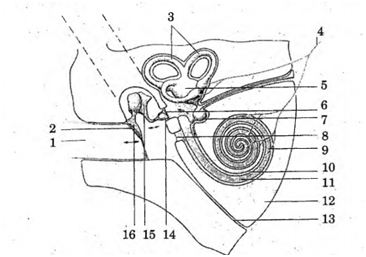
Zoology 5c (i) Name the parts.
Zoology 5c (ii) Name the inner ossicles.
Zoology 5c (iii) Name the parts of cochlea.
Zoology 5c (iv) What is the organ of corti?
Zoology 5c (v) What are the steps by which sound waves at the eardrum cause impulse generation in the cells of organ of corti?
Zoology 5d Differentiate between saturated and unsaturated fatty acids and their functions (IAS 2015 Marks,10 Marks)
Zoology 5e Differentiate between Innate and Adaptive immunity. Justify your answer with suitable examples. (IAS 2015 Marks,10 Marks)
Zoology 6a Explain with diagrams the molecular mechanism of contraction of skeletal muscles. Discuss the role of ions and bioenergetics in muscle contraction. Attribute the cause(s) for muscle cramps. (IAS 2015 Marks,20 Marks)
Zoology 6b What is metamorphosis? Differentiate between retrogressive and progressive metamorphosis, with figures and examples. How are they regulated? (IAS 2015 Marks,15 Marks)
Zoology 6c Define hormones. Distinguish between Steroid and Peptide hormones. Give the name of the hormones and its mechanism of action that uses Ca+2 and/or Calcitonin as second messenger. (IAS 2015 Marks,15 Marks)
Zoology 7a What are caspase enzymes? Narrate their crucial role in cell death. (IAS 2015 Marks,15 Marks)
Zoology 7b Diffeentiate between totipotent and multipotent cells with suitable examples. Explain the use of stem cells in human diseases. (IAS 2015 Marks,20 Marks)
Zoology 7c What is an active site? How does enzyme catalysis take place in an active site? Explain with suitable examples (IAS 2015 Marks,15 Marks)
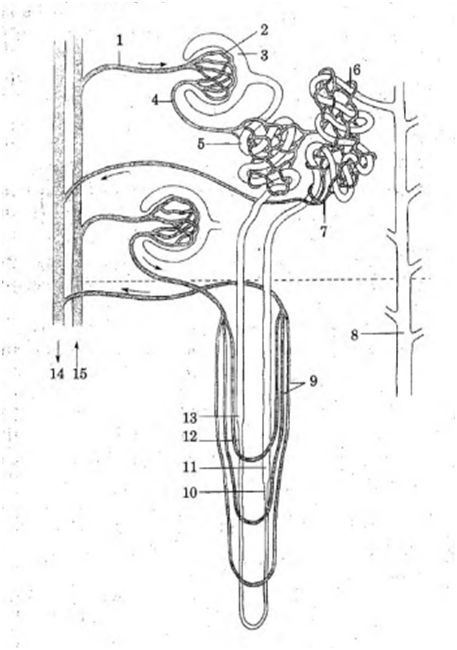
Zoology 8a Label the parts of nephron and the answer the following questions: (IAS 2015 Marks,20 Marks)
Zoology 8a (i) Which region of the kidney contains malpighian body, loop of Henle and collecting ducts?
Zoology 8a (ii) What is Glomerular filtration rate?
Zoology 8a (iii) Write the steps, of urine formation.
Zoology 8a (iv) What is the effect of vasopressin, oxytocin and aldosterone in renal- function?
Zoology 8a (v) What is the holding capacity, of urinary bladder in man and the term used for the discharge of urine?
Zoology 8b Explain the role of salivary glands, liver, pancreas and intestinal glands in fat and carbohydrate digestion. (IAS 2015 Marks,15 Marks)
Zoology 8c Which stage of the development is used to produce the transgenic animals? How is it done? (IAS 2015 Marks,15 Marks)