
Draw an ultrastructure of plasma membrane. Discuss the roles of lipids in the regulation of membrane fluidity. (IAS 2020/15 Marks)
Draw an ultrastructure of plasma membrane. Discuss the roles of lipids in the regulation of membrane fluidity. (IAS 2020/15 Marks)

Introduction
The plasma membrane is a crucial component of all cells, serving as a barrier that separates the internal environment of the cell from the external environment. It is composed of a phospholipid bilayer with embedded proteins and plays a vital role in maintaining cell integrity and regulating the passage of molecules in and out of the cell.
Ultrastructure of Plasma Membrane
- Structure Overview: The plasma membrane is primarily composed of a phospholipid bilayer, proteins, cholesterol, and carbohydrate molecules. It serves as a selective barrier between the cell’s internal and external environments.
- Phospholipid Bilayer
- Composed of two layers of phospholipids with hydrophilic heads facing outward and hydrophobic tails facing inward.
- Provides structural integrity and a hydrophobic core that limits the passage of water-soluble substances.
- Membrane Proteins
- Embedded proteins (integral and peripheral) serve various functions like transport, cell signaling, and maintaining cell shape.
- Integral proteins span the membrane, while peripheral proteins are attached to its surface.
- Cholesterol Molecules: Interspersed within the phospholipid bilayer, cholesterol regulates fluidity and stabilizes the membrane structure, especially under temperature variations.
- Carbohydrates: Found on the outer surface of the membrane, often attached to proteins (glycoproteins) or lipids (glycolipids), carbohydrates are involved in cell recognition and signaling.
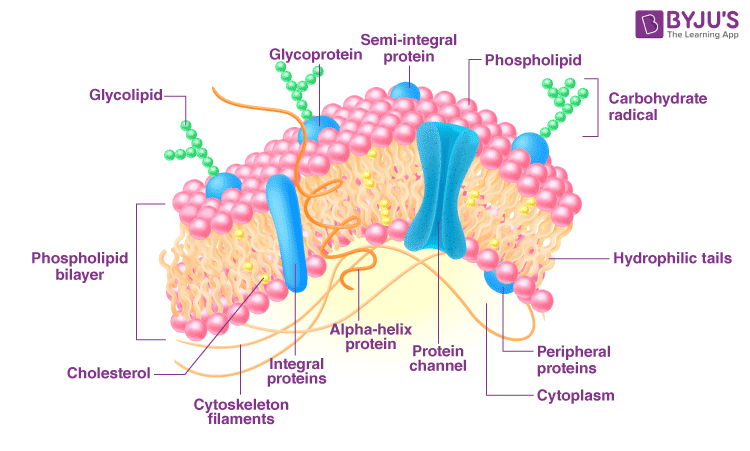
Roles of Lipids in the Regulation of Membrane Fluidity
- Phospholipid Composition
- Saturated vs. unsaturated fatty acids in phospholipids influence fluidity:
- Saturated fatty acids (straight chains) make the membrane less fluid.
- Unsaturated fatty acids (kinked chains) increase membrane fluidity due to the presence of double bonds, which prevent tight packing.
- Saturated vs. unsaturated fatty acids in phospholipids influence fluidity:
- Cholesterol's Role in Fluidity
- Cholesterol acts as a fluidity buffer:
- At low temperatures, it prevents phospholipids from clustering too closely, maintaining membrane fluidity.
- At high temperatures, cholesterol stabilizes the membrane, reducing excessive fluidity by restraining phospholipid movement.
- Cholesterol acts as a fluidity buffer:
- Temperature Dependence
- The membrane's fluidity adapts to temperature changes:
- At lower temperatures, unsaturated fatty acids maintain fluidity to ensure proper function.
- High temperatures can lead to increased fluidity, which cholesterol helps control to prevent membrane instability.
- The membrane's fluidity adapts to temperature changes:
- Role in Cellular Processes
- Membrane fluidity impacts various cellular functions, including protein function, signal transduction, and the ability of cells to undergo endocytosis and exocytosis.
- Proper fluidity ensures that proteins and lipids can move within the membrane, aiding in cellular communication and response to environmental changes.
Conclusion
The plasma membrane is a dynamic structure composed of lipids and proteins that play essential roles in maintaining cell integrity and regulating cellular processes. Lipids, particularly phospholipids and cholesterol, play a crucial role in regulating membrane fluidity, which is essential for the proper functioning of the cell.