
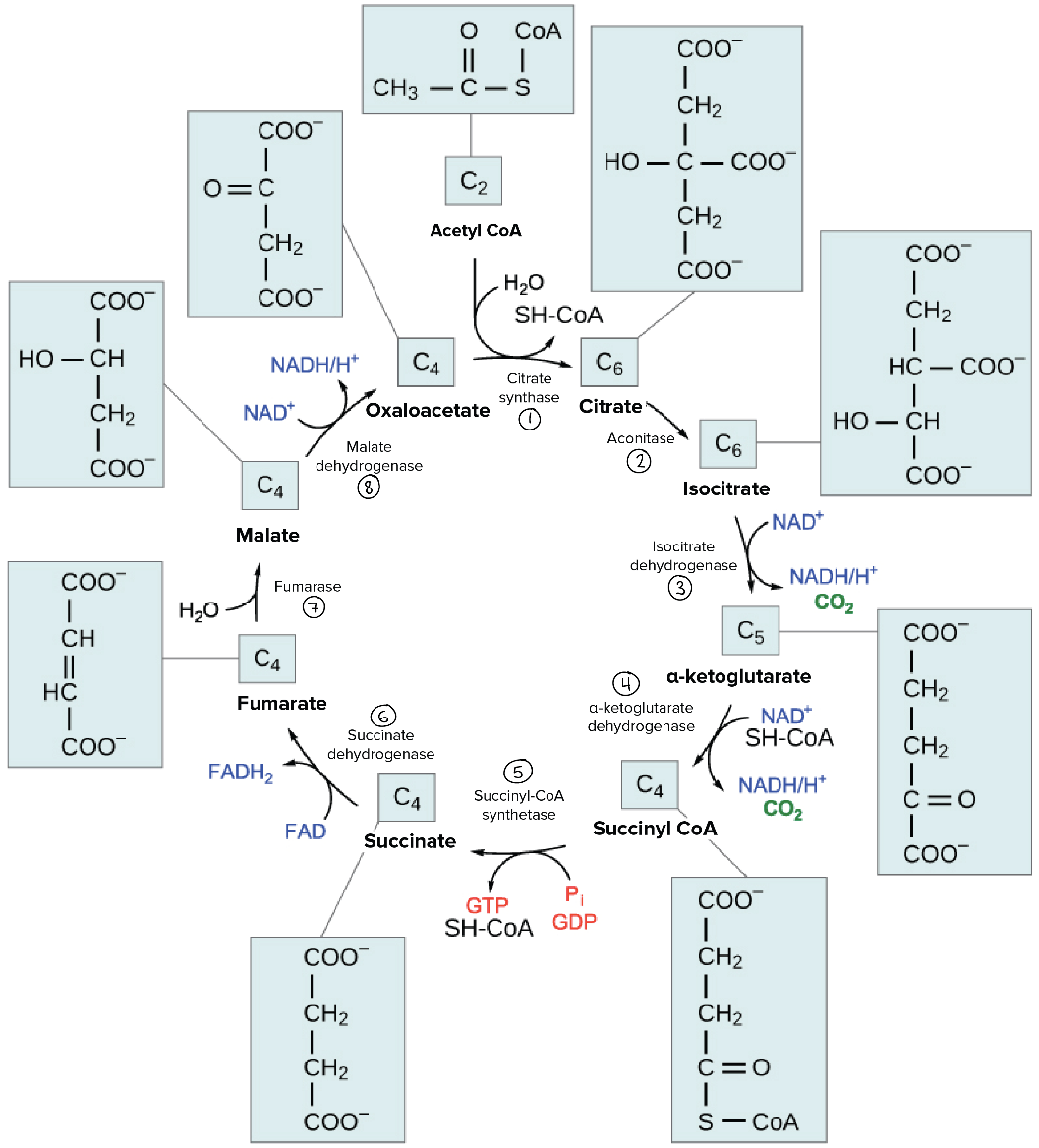
Give a diagrammatic representation of citric acid cycle and discuss its role in metabolism. (IFS 2020, 15 Marks)
Give a diagrammatic representation of citric acid cycle and discuss its role in metabolism. (IFS 2020, 15 Marks)

Introduction
The citric acid cycle, also known as the Krebs cycle or tricarboxylic acid cycle, is a series of chemical reactions that take place in the mitochondria of eukaryotic cells. It plays a crucial role in the metabolism of carbohydrates, fats, and proteins, ultimately leading to the production of ATP, the energy currency of the cell.
Steps of the Citric Acid Cycle
- Formation of Citrate: Acetyl-CoA (derived from carbohydrates, fatty acids, or amino acids) combines with oxaloacetate (a 4-carbon molecule) to form citrate (6-carbon).
- Isomerization of Citrate: Citrate is rearranged to form isocitrate, which involves an intermediate called cis-aconitate.
- Oxidation of Isocitrate: Isocitrate is oxidized to form alpha-ketoglutarate (5-carbon), reducing NAD+ to NADH and releasing CO2.
- Formation of Succinyl-CoA: Alpha-ketoglutarate undergoes decarboxylation, producing succinyl-CoA (4-carbon) and reducing NAD+ to NADH, releasing another CO2 molecule.
- Conversion to Succinate: Succinyl-CoA is converted to succinate by a substrate-level phosphorylation, generating one molecule of GTP or ATP.
- Oxidation to Fumarate: Succinate is oxidized to form fumarate, reducing FAD to FADH2 in the process.
- Hydration to Malate: Fumarate undergoes hydration (addition of water) to form malate.
- Oxidation to Oxaloacetate: Malate is oxidized to regenerate oxaloacetate, producing NADH in the process. This allows the cycle to continue.
Role of the Citric Acid Cycle in Metabolism
- Energy Production: The primary function of the citric acid cycle is to generate high-energy electron carriers, namely NADH and FADH2, which are then used in the electron transport chain to produce ATP, the main energy currency of the cell.
- Carbon Dioxide Release: During the cycle, two molecules of carbon dioxide are released per turn, which is exhaled as waste during respiration.
- Intermediate Synthesis: Several intermediates of the citric acid cycle serve as precursors for the synthesis of amino acids, nucleotides, and lipids. This makes the cycle a central hub in cellular biosynthesis.
- Integration with Other Metabolic Pathways: The citric acid cycle is closely linked to various other metabolic pathways, such as glycolysis and fatty acid oxidation. Intermediates from these pathways feed into the citric acid cycle, facilitating the breakdown of glucose and fatty acids for energy production.
- Regulation of Metabolism: The citric acid cycle is tightly regulated by key enzymes, including citrate synthase, isocitrate dehydrogenase, and alpha-ketoglutarate dehydrogenase. These enzymes are regulated by factors such as ATP and NADH levels, ensuring that energy production is in sync with the cell’s needs.
Conclusion
The citric acid cycle is a fundamental pathway in cellular metabolism, playing a central role in the oxidation of acetyl-CoA and the production of ATP. Its intricate series of reactions and intermediates make it a key player in the integration of various metabolic pathways, ultimately contributing to the overall energy balance and homeostasis of the cell.