
Evolutionary status of Onychophora (IAS 2023/10 Marks)
Evolutionary status of Onychophora (IAS 2023/10 Marks)

Introduction
Onychophora, commonly known as velvet worms, are a small phylum of invertebrates that are often considered to be a transitional group between annelids (segmented worms) and arthropods (insects, spiders, crustaceans, etc.). Their evolutionary status has been a subject of debate among scientists due to their unique combination of characteristics.
Evolutionary Status of Onychophora
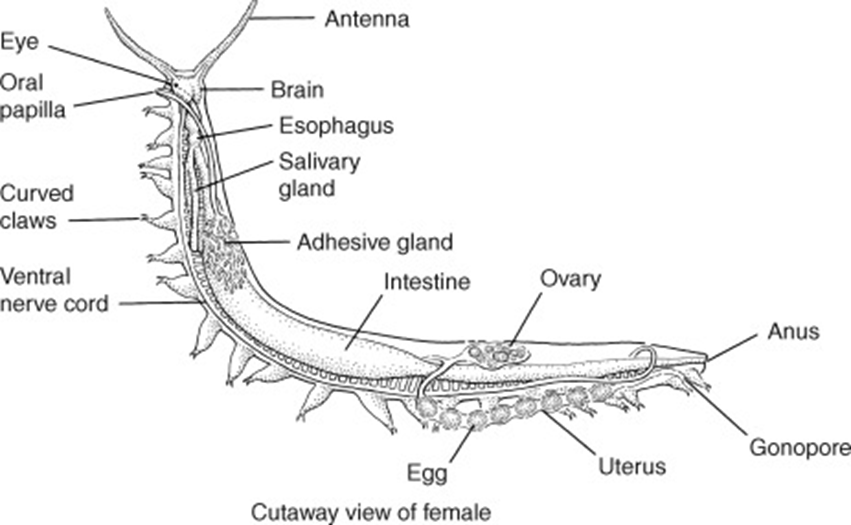
1. Phylum
- Taxonomic Position: Onychophora is a small phylum under the kingdom Animalia, encompassing about 200 species.
- Characteristics: They are characterized by soft, segmented bodies, numerous legs, and a worm-like appearance. They possess a unique predatory feeding mechanism using slime for capturing prey.
2. Phylogenetic Relationships
- Sister Group to Arthropods: Onychophorans share a closer evolutionary relationship with arthropods (insects, arachnids, and crustaceans) than with annelids, though they exhibit traits of both groups.
- Key Features: The presence of jointed appendages (similar to arthropods) and a soft body structure (similar to annelids) suggests a transitional evolutionary state.
3. Ancestral Traits
- Trilobite-Like Features: Some morphological features in Onychophora resemble ancient trilobites, indicating they may retain primitive traits from early arthropod ancestors.
- Soft Body and Segmentation: Their segmented body structure is akin to annelids, highlighting the evolutionary divergence from a common ancestor shared with both groups.
4. Developmental Biology
- Indirect Development: Onychophorans exhibit a unique mode of development, with larvae that undergo metamorphosis, which is also seen in some arthropods.
- Embryonic Similarities: The embryonic development of Onychophora displays similarities to both annelids and arthropods, reinforcing their intermediate position in evolutionary history.
5. Adaptations and Survival
- Moist Habitats: Onychophorans are primarily found in humid, tropical environments, reflecting adaptations for terrestrial life.
- Predatory Adaptations: Their slime production for prey capture and locomotion adaptations signify evolutionary advancements for survival in diverse habitats.
6. Examples of Onychophora
- Peripatus: Often referred to as the "living fossil," this genus exemplifies primitive features and provides insights into the evolutionary lineage.
- Euperipatoides: Found in Australia, this genus shows varied adaptations to its environment, demonstrating the ecological diversity within Onychophora.
Conclusion
The evolutionary status of Onychophora remains a topic of ongoing research and debate in the field of zoology. While their unique combination of characteristics suggests a close relationship to both annelids and arthropods, further studies are needed to fully understand their evolutionary history.