
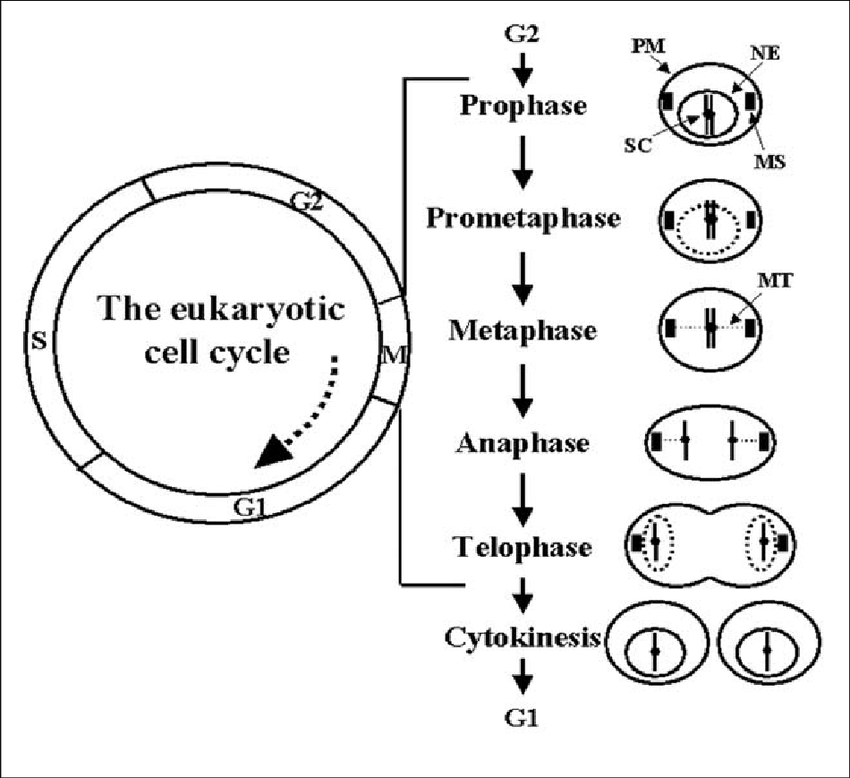
Draw an overview of eukaryotic cell cycle. Describe the roles of cyclins in the regulation of cell cycle. (IAS 2020/20 Marks)
Draw an overview of eukaryotic cell cycle. Describe the roles of cyclins in the regulation of cell cycle. (IAS 2020/20 Marks)

Introduction
The eukaryotic cell cycle is a complex process that involves a series of events that lead to cell growth and division. It consists of interphase, which includes G1, S, and G2 phases, followed by mitosis or meiosis. The cell cycle is tightly regulated by various proteins, including cyclins, which play a crucial role in controlling the progression of the cell cycle.
Eukaryotic Cell Cycle
The eukaryotic cell cycle is a series of phases that a cell goes through from its formation to the point it divides into two daughter cells. It is divided into four main phases: G1, S, G2, and M.
- G1 Phase (Gap 1)
- The cell grows and carries out normal metabolic processes.
- Prepares for DNA synthesis by producing the necessary proteins and energy.
- S Phase (Synthesis)
- DNA replication occurs, resulting in two copies of each chromosome.
- Important for accurate transmission of genetic material to daughter cells.
- G2 Phase (Gap 2)
- Further cell growth and preparation for mitosis.
- Checks for DNA replication errors and repairs any damage.
- M Phase (Mitosis)
- The cell undergoes mitosis, dividing its chromosomes and cytoplasm to form two daughter cells.
- Includes phases: prophase, metaphase, anaphase, and telophase, followed by cytokinesis.
- G0 Phase (Quiescent Stage)
- Some cells exit the cycle and enter a resting phase where they do not divide.
- Common in terminally differentiated cells (e.g., neurons) or cells that are not actively dividing.
Roles of Cyclins in the Regulation of Cell Cycle
Cyclins are a family of proteins that control the progression of cells through the cell cycle by activating cyclin-dependent kinases (CDKs). Cyclin levels fluctuate during different phases, which allows them to act as checkpoints and regulate the timing of cell cycle events.
- G1 Cyclins (Cyclin D)
- Bind to CDK4 and CDK6, promoting the transition from G1 to S phase.
- Help in the decision-making process of whether the cell will proceed with division or enter G0.
- S Cyclins (Cyclin E and Cyclin A)
- Cyclin E associates with CDK2 to trigger the onset of the S phase.
- Cyclin A continues to bind CDK2 during S phase to ensure DNA synthesis is completed properly.
- G2/M Cyclins (Cyclin B)
- Bind with CDK1 to initiate mitosis.
- Responsible for entering the M phase by promoting the condensation of chromosomes and breakdown of the nuclear envelope.
- Cyclin Degradation and Cell Cycle Exit
- Cyclins are degraded at specific points to ensure cell cycle progression is irreversible.
- Regulated degradation prevents reactivation of the cell cycle machinery until the next appropriate phase.
Conclusion
Cyclins play a crucial role in the regulation of the eukaryotic cell cycle by controlling the progression through different phases of the cycle. Their timely expression and degradation ensure that the cell cycle is properly coordinated and that cells divide accurately.