
Give an illustrated account of life cycle of Leishmania. (IAS 2021/15 Marks Marks)
Give an illustrated account of life cycle of Leishmania. (IAS 2021/15 Marks Marks)

Introduction
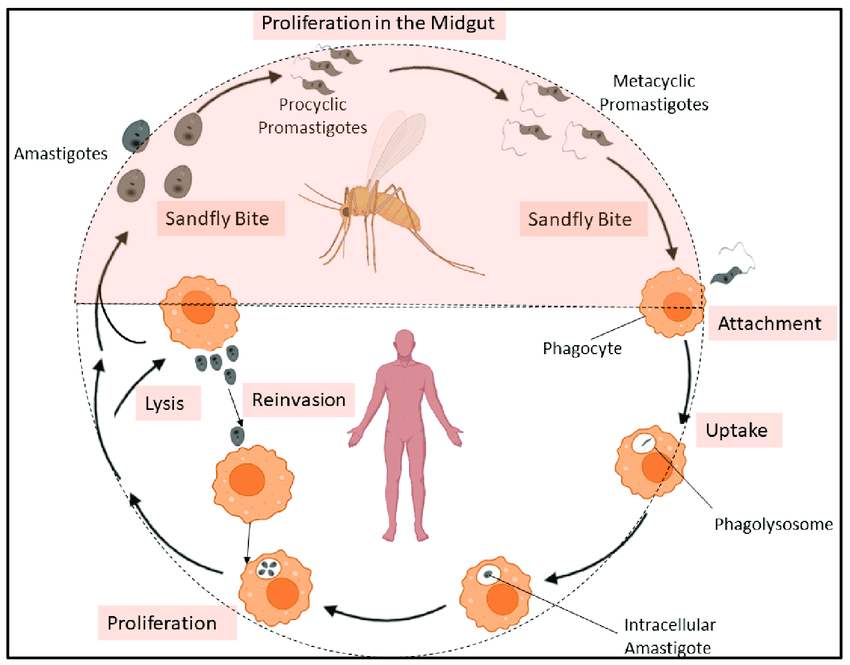
Leishmania is a genus of parasitic protozoa that causes the disease leishmaniasis in humans and animals. The life cycle of Leishmania involves both an insect vector and a mammalian host, with different stages of development occurring in each.
Life Cycle of Leishmania
These parasites have a complex life cycle that alternates between two main hosts: the sandfly and the mammalian host (typically humans or other animals).
1. Stages of the Life Cycle
- Promastigote Stage
- Description: This is the flagellated, extracellular form of the parasite found in the gut of the sandfly.
- Characteristics: Promastigotes are elongated and motile, equipped with a single flagellum. They multiply by binary fission.
- Sandfly Infection
- Process: When a sandfly bites a mammalian host, it injects saliva containing the promastigotes into the bloodstream.
- Entry Point: The promastigotes enter the dermal tissues of the host, where they are taken up by macrophages.
- Amastigote Stage
- Description: Inside the macrophages, promastigotes transform into amastigotes.
- Characteristics: Amastigotes are round, non-flagellated forms that multiply by binary fission within the host cells.
- Location: They reside in the cytoplasm of macrophages and other mononuclear phagocytic cells.
- Transmission Back to Sandflies
- Process: When an infected mammalian host is bitten by a sandfly, the amastigotes are taken up along with the blood meal.
- Transformation: Inside the sandfly, amastigotes differentiate back into promastigotes in the gut of the insect, completing the life cycle.
2. Examples of Leishmania Species
- Leishmania donovani
- Associated Disease: Causes visceral leishmaniasis (Kala-azar), characterized by fever, weight loss, and enlargement of the liver and spleen.
- Transmission: Primarily transmitted by the bite of infected female sandflies of the genus Phlebotomus.
- Leishmania braziliensis
- Associated Disease: Causes cutaneous and mucocutaneous leishmaniasis, leading to skin ulcers and nasal/mouth lesions.
- Transmission: Commonly transmitted by Lutzomyia sandflies.
- Leishmania tropica
- Associated Disease: Causes cutaneous leishmaniasis, resulting in skin sores.
- Transmission: Typically transmitted by Phlebotomus sandflies in rural and urban settings.
3. Epidemiological Significance
- Vector Control: Understanding the life cycle is crucial for developing control measures against leishmaniasis. Strategies may include vector control (e.g., insecticide-treated nets) and public health education.
- Prevention of Transmission: Reducing exposure to sandflies and preventing bites can significantly lower infection rates.
Conclusion
The life cycle of Leishmania is complex and involves both insect and mammalian hosts. The stages of development of the parasite is crucial for developing effective control measures for leishmaniasis.