
What do you understand about Torsion and Detorsion in Mollusca? Elucidate. (IAS 2019/15 Marks)
What do you understand about Torsion and Detorsion in Mollusca? Elucidate. (IAS 2019/15 Marks)

Introduction:
Torsion and detorsion are unique features of mollusks that play a crucial role in their development and physiology. Understanding these processes can provide insights into the evolution and adaptation of these fascinating creatures.
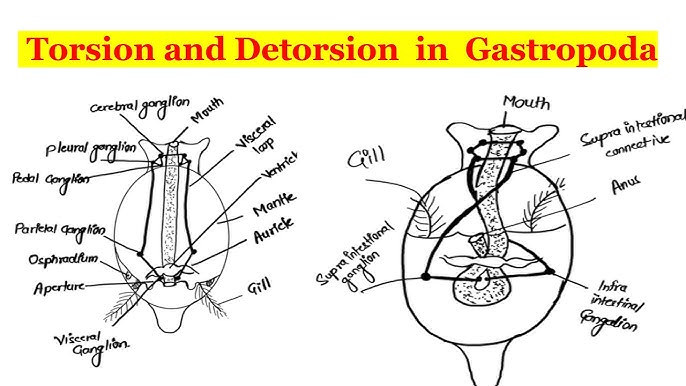
Torsion in Mollusca
- Definition: Torsion is a unique twisting process occurring during the larval development of gastropod mollusks, resulting in a 180° rotation of the visceral mass, mantle, and shell.
- Process: This rotation occurs in two stages, starting with a rapid twist and followed by a slower rotation, completing a full 180° twist.
- Symmetry Changes: Torsion disrupts the bilateral symmetry of the mollusk, making the body asymmetrical and rearranging internal organs.
- Resulting Body Structure: The animal’s mantle cavity, which contains the gills, anus, and excretory organs, moves to the front above the head due to torsion.
- Survival Advantage: Torsion is thought to provide defensive advantages, allowing the mollusk to withdraw its head into the shell more quickly in response to threats.
- Reproductive Implications: Torsion positions the reproductive and excretory openings closer to the head, aiding reproductive and excretory efficiency.
- Sensory Adaptation: The relocation of sensory organs allows the animal to detect changes in its environment near its head, improving its chances of survival.
- Variety Among Gastropods: Torsion is unique to gastropods among mollusks and is a major factor in the diversity of body forms within the group.
Detorsion in Mollusca
- Definition: Detorsion is the partial or complete reversal of the 180° twist that occurred during torsion, typically occurring in later stages of development or adulthood in some gastropods.
- Occurrence: Detorsion is seen in certain gastropod groups, especially within the Opisthobranchia (sea slugs) and Pulmonata (land snails).
- Process: This process involves the repositioning of the mantle cavity, gills, and other organs back toward the posterior end of the body.
- Reversal of Asymmetry: Detorsion reduces or reverses the asymmetry created by torsion, returning the body to a more bilaterally symmetrical structure.
- Adaptive Significance: Detorsion may improve respiratory efficiency by repositioning the gills away from the head, where they are less likely to encounter waste expelled from the body.
- Streamlining Body Shape: Detorsion contributes to a more streamlined body shape, which is advantageous for burrowing, crawling, or other locomotive activities.
- Protection from Predation: In detorted species, the body’s new layout may provide better physical protection, especially for animals that have lost the ability to fully retract into their shells.
- Evolutionary Adaptation: Detorsion is considered an evolutionary adaptation in response to different ecological niches and is common in mollusks that have evolved to occupy unique habitats.
Conclusion:
Torsion and detorsion are fascinating processes that highlight the adaptability and complexity of mollusks. By studying these mechanisms, researchers can gain a better understanding of the evolutionary history and ecological roles of these diverse creatures.