
Describe the respiratory organs and mechanism of respiration in Pila. (IAS 2021/15 Marks Marks)
Describe the respiratory organs and mechanism of respiration in Pila. (IAS 2021/15 Marks Marks)

Introduction:
Pila is a genus of freshwater snails that are commonly found in ponds and slow-moving streams. Like all living organisms, Pila also undergo respiration to obtain the necessary oxygen for survival.
Respiratory Organs of Pila
Pila, a freshwater snail, uses both aquatic and aerial respiration and has specialized organs for each.
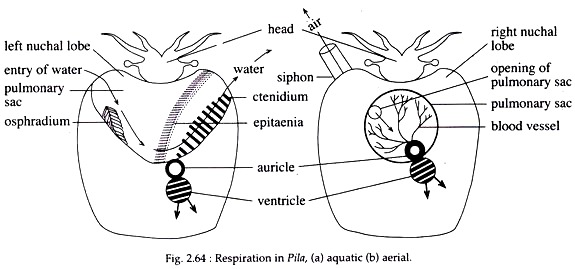
- Gill (Ctenidium):
- Located in the mantle cavity; helps in aquatic respiration.
- Composed of leaf-like folds, which increase the surface area for gas exchange.
- Pulmonary Sac (Lung):
- Acts as a lung for aerial respiration; found in the upper part of the mantle cavity.
- It has a vascular network that facilitates gas exchange with air.
- Mantle Cavity:
- Serves as a common space for both gill and pulmonary sac.
- Plays a dual role in facilitating respiration in both aquatic and terrestrial environments.
- Osphradium:
- A sensory organ located near the gill.
- Helps detect water quality, aiding the snail in deciding when to breathe underwater.
- Pneumostome:
- A small opening on the body surface, used for aerial respiration.
- Allows the entry of air into the pulmonary sac.
- Muscular Wall of Pulmonary Sac:
- Contains muscles that assist in ventilation by contracting and expanding the sac.
- Helps in drawing in and expelling air.
- Respiratory Pigments:
- Hemocyanin is present in blood, aiding in oxygen transportation.
- This copper-based pigment gives the blood a bluish color, enhancing oxygen-carrying capacity.
- Rich Blood Supply:
- Both the gill and pulmonary sac are richly supplied with blood vessels.
- Allows efficient gas exchange with minimal resistance.
Mechanism of Respiration in Pila
The dual-respiratory system in Pila enables it to survive in both water and air environments.
- Aquatic Respiration via Gills:
- When submerged, Pila relies on its gill for respiration.
- Water flows over the gill, and oxygen is absorbed into the blood while carbon dioxide diffuses out.
- Aerial Respiration via Pulmonary Sac:
- In the absence of water or during dry conditions, Pila uses the pulmonary sac.
- Air enters through the pneumostome, and oxygen diffuses into the vascularized walls.
- Role of Pneumostome in Air Intake:
- The pneumostome opens and closes to control air intake.
- This structure helps prevent water from entering the pulmonary sac while submerged.
- Alternate Respiration:
- Pila can switch between gill and pulmonary sac respiration based on environmental conditions.
- This adaptation is essential for survival in fluctuating aquatic environments.
- Use of Muscular Wall in Pulmonary Ventilation:
- The contraction and relaxation of the pulmonary sac’s muscular wall create pressure changes.
- These changes help draw air in and expel waste gases.
- Regulation by Osphradium:
- The osphradium monitors water quality and detects low oxygen levels.
- Signals the snail to shift to aerial respiration when needed.
- Reduction of Metabolic Rate in Low Oxygen:
- During droughts or low oxygen availability, Pila can lower its metabolic rate.
- This minimizes oxygen demand, allowing survival in extreme conditions.
- Hemocyanin Function:
- Hemocyanin in the blood binds to oxygen efficiently, similar to hemoglobin in humans.
- Enables efficient oxygen transport even in low-oxygen environments.
Conclusion:
Respiration in Pila is a vital process that ensures the survival of these freshwater snails. Through their gills and efficient vascular system, Pila are able to extract oxygen from the water and remove carbon dioxide, allowing them to thrive in their aquatic habitats.