
Describe the respiratory organs and mechanism of respiration in Sepia. (IAS 2024/15 Marks)
Describe the respiratory organs and mechanism of respiration in Sepia. (IAS 2024/15 Marks)

Introduction:
Sepia is a type of cuttlefish that belongs to the class Cephalopoda. Like other cephalopods, Sepia also undergoes respiration to obtain oxygen for survival.
Respiratory Organs of Sepia
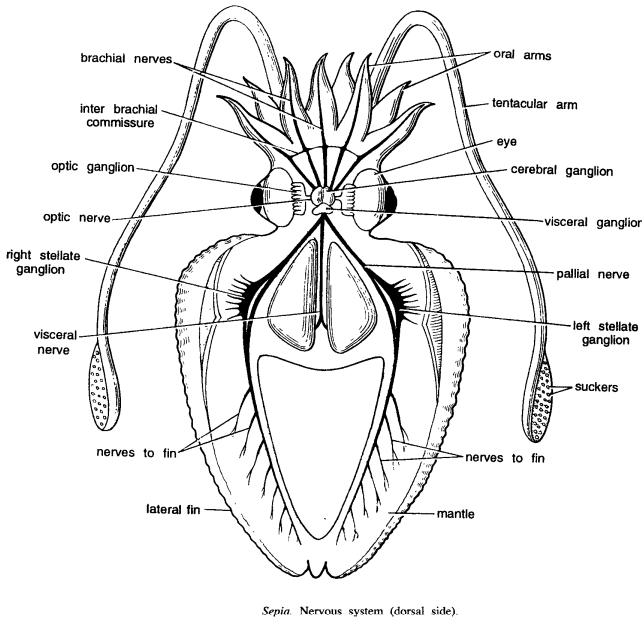
- Gills (Ctenidia)
- Sepia, like other cephalopods, uses a pair of feather-like gills known as ctenidia for respiration.
- These gills are located within the mantle cavity, where water flows over them, facilitating gas exchange.
- Mantle Cavity
- The mantle cavity houses the gills and serves as the primary chamber for water circulation.
- It acts as a protective space and ensures a continuous flow of oxygenated water over the gills.
- Gill Lamellae
- Each gill comprises numerous tiny lamellae, increasing the surface area for gas exchange.
- The lamellae enhance efficiency by allowing more oxygen to diffuse into the blood.
- Branchial Hearts
- Sepia has two branchial hearts at the base of each gill, pumping blood through the gills.
- These hearts increase blood pressure in the gills, ensuring efficient oxygenation.
- Hemocyanin in Blood
- Hemocyanin, a copper-based respiratory pigment, is present in Sepia’s blood.
- It binds to oxygen in the gills and helps transport it to other body tissues.
- Siphon (Funnel)
- The siphon plays a role in expelling water from the mantle cavity after gas exchange.
- It enables jet propulsion and controls the direction of water flow, aiding respiration.
- Epidermal Glands
- Specialized glands in the epidermis can aid in maintaining a moist environment within the mantle cavity.
- This helps regulate the gill’s efficiency and protects them from desiccation.
- Pallial Cartilage
- The mantle cavity is supported by pallial cartilage, which provides structure and helps maintain the shape of the respiratory cavity.
- It ensures optimal water flow over the gills, improving respiration.
Mechanism of Respiration in Sepia
- Water Intake through Mantle Contraction
- The mantle expands to draw oxygenated water into the mantle cavity.
- This flow is essential for providing fresh water over the gills continuously.
- Passage of Water over Gills
- The incoming water passes over the gill lamellae, where oxygen diffuses into the blood.
- Simultaneously, carbon dioxide diffuses out from the blood to the water.
- Oxygen Transport via Hemocyanin
- Oxygen binds to hemocyanin in the gill capillaries, giving the blood an oxygen-rich state.
- Hemocyanin ensures efficient oxygen transport, similar to hemoglobin in vertebrates.
- Role of Branchial Hearts
- The branchial hearts pump blood into the gills, boosting circulation.
- This action increases the rate of oxygen uptake and enhances metabolic efficiency.
- Siphon Expulsion Mechanism
- After gas exchange, water is expelled through the siphon by mantle contraction.
- This helps maintain continuous circulation within the mantle cavity.
- Jet Propulsion as Auxiliary Respiration
- Expelling water through the siphon aids in movement, but it also promotes water exchange in the gills.
- This dual-purpose mechanism supports both respiration and locomotion.
- Respiratory Rhythm Modulation
- Sepia can adjust the rhythm of mantle contractions to meet oxygen demand.
- During active movement, faster contractions increase oxygen intake.
- Active vs. Resting Respiration
- Sepia’s respiratory rate increases during active swimming to accommodate higher oxygen demand.
- At rest, the mantle contractions slow down, conserving energy and oxygen.
Conclusion:
Respiration in Sepia is a complex process that involves gills, water flow, hemocyanin, and skin respiration. These mechanisms work together to ensure that Sepia can obtain enough oxygen to support its metabolic needs and survive in its aquatic environment.