
Describe the Dentition in Mammals along with relevant diagrams. (IAS 2019/20 Marks)
Describe the Dentition in Mammals along with relevant diagrams. (IAS 2019/20 Marks)

Introduction:
Dentition in mammals refers to the arrangement and number of teeth in their mouths. Mammals have different types of teeth that are specialized for various functions such as cutting, tearing, and grinding food.
Dentition in Mammals
Dentition refers to the arrangement, type, and number of teeth in an organism. Mammals show a wide variety of dental adaptations due to their diverse diets and lifestyles.
Types of Teeth in Mammals
- Incisors (I):
- Located at the front of the mouth.
- Used for cutting or nibbling food.
- Example: Rodents have prominent incisors for gnawing.
- Canines (C):
- Located next to the incisors.
- Sharp and pointed, used for tearing meat.
- Prominent in carnivores (e.g., lions).
- Premolars (P):
- Found between canines and molars.
- Used for crushing or grinding food.
- Intermediate in structure between canines and molars.
- Molars (M):
- Located at the back of the jaw.
- Flat and broad, designed for grinding and chewing.
- Prominent in herbivores (e.g., cows).
Dental Formula
- Represents the number and arrangement of teeth in one half of the jaw.
- Formula: (I,C,P,M)×2(I, C, P, M) \times 2(I,C,P,M)×2 (Upper and Lower Jaw)
- Examples:
- Humans: 2,1,2,3×2=322, 1, 2, 3 \times 2 = 322,1,2,3×2=32
- Dog: 3,1,4,2×2=423, 1, 4, 2 \times 2 = 423,1,4,2×2=42
Types of Dentition
- Heterodont Dentition:
- Mammals have different types of teeth (incisors, canines, premolars, molars).
- Example: Humans, dogs.
- Homodont Dentition:
- All teeth are of the same type.
- Rare in mammals; found in some reptiles.
- Diphyodont Dentition:
- Two sets of teeth during lifetime:
- Milk teeth (Deciduous): First set, shed in early life.
- Permanent teeth: Replace milk teeth.
- Example: Humans.
- Two sets of teeth during lifetime:
- Monophyodont Dentition:
- Only one set of teeth throughout life.
- Rare in mammals.
Dental Adaptations in Mammals
- Carnivores:
- Sharp canines for capturing and tearing prey.
- Premolars and molars with cutting edges (e.g., carnassial teeth in cats).
- Herbivores:
- Incisors for cutting vegetation.
- Broad molars and premolars for grinding cellulose-rich food.
- Example: Cows, horses.
- Omnivores:
- Combination of sharp and flat teeth for varied diets.
- Example: Humans, bears.
- Rodents:
- Continuously growing incisors for gnawing.
- No canines; a gap (diastema) separates incisors and molars.
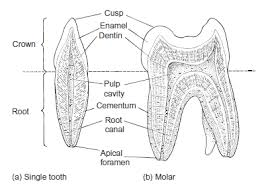
Diagram Explanation:
Conclusion:
Dentition in mammals is adapted to their specific dietary needs and feeding habits. The arrangement and types of teeth in mammals play a crucial role in their ability to effectively process and digest food.