
Describe the different larval forms of Crustaceans with suitable diagrams. (IAS 2024/20 Marks)
Describe the different larval forms of Crustaceans with suitable diagrams. (IAS 2024/20 Marks)

Introduction:
Crustaceans are a diverse group of arthropods that undergo metamorphosis during their development, transitioning through various larval stages before reaching adulthood. These larval forms are adapted to different environments and feeding strategies, allowing the crustaceans to survive and thrive in a variety of habitats.
Larval Forms of Crustaceans
Crustaceans exhibit a wide variety of larval forms due to their diverse life histories. These larval stages often represent transitional forms, aiding in dispersal and development.
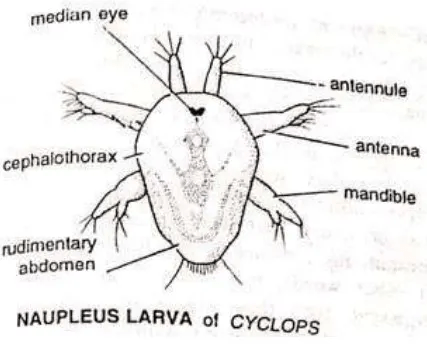
1. Nauplius
- Characteristics:
- The simplest and most primitive larval form.
- Body divided into head and trunk regions.
- Bears three pairs of appendages: antennules, antennae, and mandibles.
- A single median eye is present (naupliar eye).
- Appendages function in swimming and feeding.
- Significance:
- Found in most crustaceans, either as a free-swimming stage or during embryonic development.
2. Zoea
- Characteristics:
- Common in decapods like crabs and shrimps.
- Large cephalothorax with spines and a long abdomen.
- Well-developed eyes and thoracic appendages for swimming.
- Feeds actively on plankton.
- Significance:
- Promotes dispersal in marine environments.
3. Mysis (Schizopod)
- Characteristics:
- Intermediate stage, found in shrimps and some other decapods.
- Resembles the adult but with underdeveloped appendages.
- Thoracic appendages become functional for swimming.
- Significance:
- Transitional phase leading to the adult stage.
4. Megalopa
- Characteristics:
- Found in crabs as a stage following zoea.
- Larger body with more developed appendages.
- Abdomen becomes reduced, and the adult body plan starts to emerge.
- Begins adapting to benthic (bottom-dwelling) life.
- Significance:
- Marks the shift from larval to adult habitat.
5. Phyllosoma
- Characteristics:
- Transparent and flattened larval stage found in spiny lobsters.
- Long legs and large spiny appendages.
- Adapted for a planktonic lifestyle.
- Significance:
- Enhances dispersal in oceanic waters.
6. Cyprid
- Characteristics:
- Unique to barnacles.
- A non-feeding stage with a bivalve-like shell.
- Has specialized appendages to attach to a substrate.
- Significance:
- Leads to the sessile adult stage in barnacles.
7. Alima
- Characteristics:
- Found in stomatopods (mantis shrimps).
- Elongated body with stalked eyes.
- Appendages adapted for predation in a planktonic environment.
- Significance:
- Represents a predatory planktonic phase.
Diagrams:
Conclusion:
The different larval forms of crustaceans play a crucial role in their development and survival. Each stage is adapted to specific environmental conditions and feeding strategies, allowing the crustaceans to navigate their way through various habitats before reaching adulthood.